
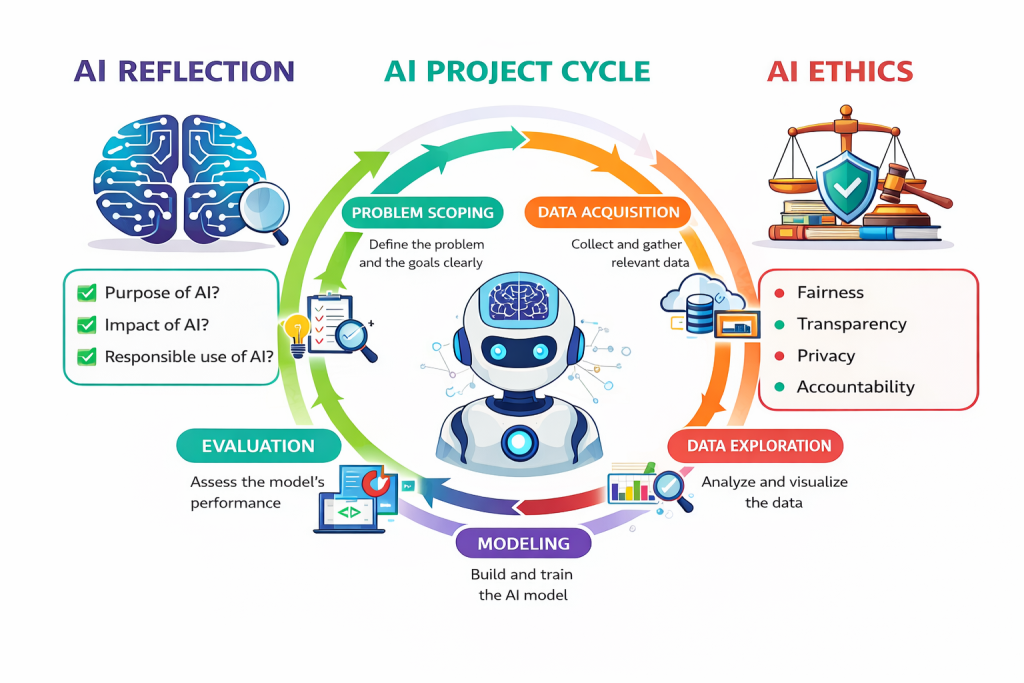
AI Reflection Project Cycle and Ethics (Unit-01)
🔹 A. Short Answer Type Questions
1. What is Artificial Intelligence?
Answer:
Artificial Intelligence (AI) is a branch of computer science that enables machines to think, learn, and make decisions like humans.
2. Give three real-life examples of Artificial Intelligence.
Answer:
- Voice assistants like Alexa and Siri
- Face recognition in smartphones
- Recommendation systems on YouTube and Netflix
3. Name the different steps involved in the AI Project Cycle.
Answer:
- Problem Scoping
- Data Acquisition
- Data Exploration
- Data Preparation
- Modeling
- Evaluation
4. Name the three main categories of Data Science.
Answer:
- Data Acquisition
- Data Analysis
- Data Visualization
5. What are the different ways to collect data?
Answer:
Data can be collected through surveys, sensors, online sources, interviews, and observations.
6. Define AI bias and give an example.
Answer:
AI bias occurs when an AI system gives unfair or incorrect results due to biased data.
Example: A hiring AI favoring one gender due to biased training data.
7. What is the problem statement template?
Answer:
A problem statement template helps clearly define the problem, objectives, and expected solution in an AI project.
8. What are the ways to visualize data?
Answer:
Data can be visualized using bar charts, pie charts, line graphs, histograms, and tables.
🔹 B. Long Answer Type Questions
1. Discuss the ethical concerns regarding Artificial Intelligence with an example.
Answer:
Ethical concerns in AI include privacy issues, bias, lack of transparency, and misuse of data.
Example: Facial recognition systems misidentifying people due to biased data.
2. Explain the concept of AI Project Cycle with a suitable example.
Answer:
The AI Project Cycle consists of steps from identifying a problem to evaluating the solution.
Example: A chatbot project follows problem scoping, data collection, training, and testing.
3. Discuss the uses of Natural Language Processing (NLP).
Answer:
NLP is used in chatbots, language translation, voice assistants, and sentiment analysis.
4. Write a note on Computer Vision.
Answer:
Computer Vision enables machines to see, identify, and process images and videos.
It is used in face recognition, self-driving cars, and medical imaging.
5. Why is ethics necessary in Artificial Intelligence?
Answer:
Ethics ensures AI systems are fair, transparent, safe, and respectful of human rights.
6. What is data visualization? Explain.
Answer:
Data visualization is the graphical representation of data to understand patterns and trends easily.
7. Why is data acquisition essential in AI projects?
Answer:
Data acquisition provides accurate data needed to train AI models effectively.
8. What are data visualization tools? Give examples.
Answer:
Data visualization tools help represent data visually.
Examples: Charts, graphs, dashboards, and spreadsheets.
🔹 C. Competency Based / Application Based Question
Question:
Plastic production harms the environment. A solution using banana peels to create bio-plastics is suggested. Which Sustainable Development Goal does this relate to?
Answer:
Responsible consumption and production
🔹 D. In Life
Imagine a future where AI enhances human capabilities. Discuss benefits and drawbacks.
Answer:
Benefits:
• Faster work
• Better healthcare
• Improved education
Drawbacks:
• Job loss
• Privacy concerns
• Over-dependence on machines
🔹 E. Deep Thinking
1. Ethical considerations in AI decision-making (Healthcare/Criminal Justice).
Answer:
AI decisions must be fair, transparent, and unbiased, especially in sensitive areas like healthcare and law.
2. Role of AI in solving global challenges.
Answer:
AI helps in climate prediction, disease detection, poverty analysis, and improving healthcare access.
3. Balancing privacy and AI-driven convenience.
Answer:
Strong data protection laws and ethical AI practices ensure privacy while using AI services.
4. Ensuring ethical practices throughout the AI project.
Answer:
By using unbiased data, ensuring transparency, protecting privacy, and evaluating social impact.
🔹 F. Project
Question:
Analyze ethical considerations in sectors like Transportation, Agriculture, or Healthcare.
Answer (Example – Healthcare):
Ethical issues include patient data privacy, AI diagnosis accuracy, and fairness in treatment recommendations.
🔹 G. Activity
Imagine working on an AI project. Outline steps to create a customer service chatbot.
Answer:
- Identify customer problems
- Collect chat data
- Clean and organize data
- Train the AI model
- Test the chatbot
- Deploy and monitor performance